


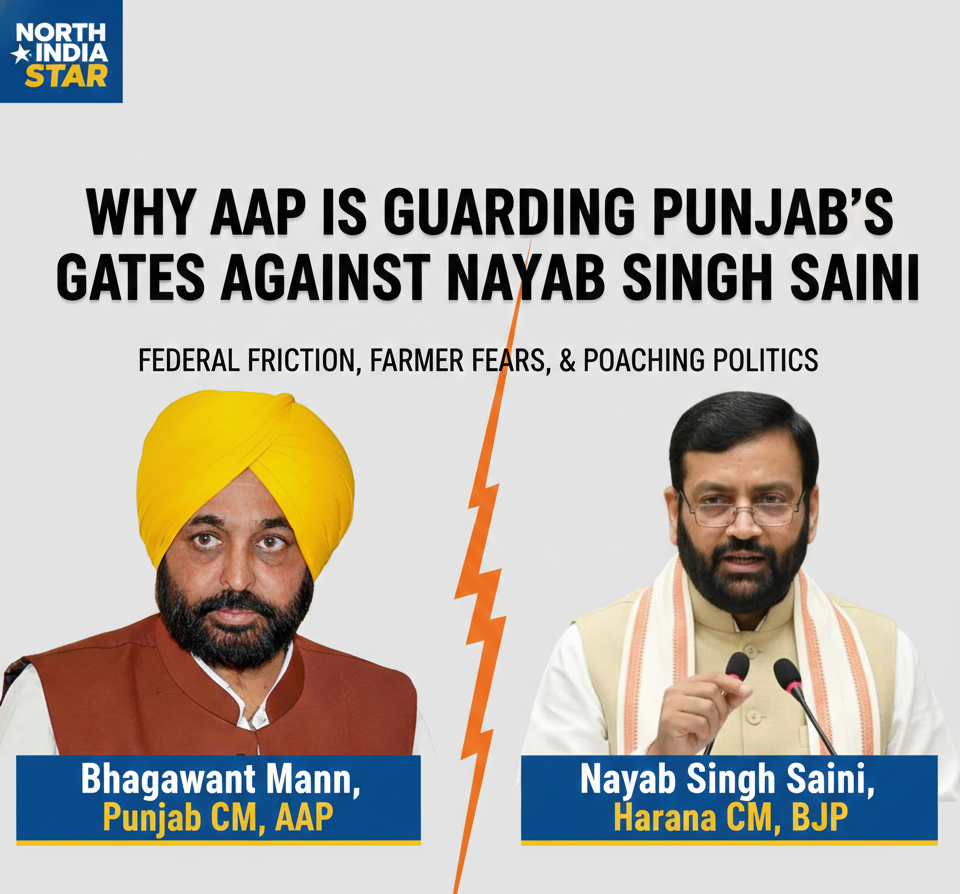
The political landscape in Punjab has transformed into a high-stakes battlefield as the 2027 Assembly elections loom on the horizon. At the centre of this storm is the Aam Aadmi Party’s (AAP) aggressive resistance to the growing footprint of Haryana Chief Minister Nayab Singh Saini. The recent massive protest at Desh Bhagat University, where Saini was compelled to cancel his visit, is far more than a local skirmish. It is a calculated manifestation of AAP’s strategic fears and the BJP’s evolving “Mission Punjab.”
For years, the BJP was perceived as a junior partner in Punjab, limited by its alliance with the Shiromani Akali Dal. Now, standing alone, the party is using Nayab Singh Saini as its primary wedge. Saini’s frequent rallies in border districts like Sangrur, Zirakpur, and Dera Bassi are deliberate. As an OBC leader with deep cultural ties to the Sikh community—his mother belongs to the community and he is fluent in Punjabi—Saini represents a “bridge” identity that threatens AAP’s diverse voter base. He has been relentless in his critique, framing the Bhagwant Mann government as a “failed experiment” and frequently contrasting Punjab’s delayed welfare promises with Haryana’s “Lado Lakshmi Yojana,” which already provides £21 per month to women. This “governance versus theatrics” narrative is designed to sow doubt among Punjab’s electorate by portraying AAP as a party of unfulfilled guarantees.
In response, AAP’s strategy has been to meet this challenge with defense through aggression. By questioning why the Punjab Governor invited a Haryana Chief Minister instead of a local minister to a Punjab-based institution, AAP is tapping into the “Punjabiyat” sentiment. They are framing the BJP’s outreach as an assault on Punjab’s federal autonomy, painting Saini as a proxy for a central government that seeks to control the state from the outside. Furthermore, AAP has successfully tethered its protests to the India-US interim trade agreement. By claiming the deal will ruin local agriculture by allowing untaxed American produce into the market, AAP is positioning itself as the sole shield for the farmers, effectively shifting the focus from their own administrative challenges to a larger existential threat from the centre.
The intensity of these protests is fuelled by deep-seated fears within the AAP camp regarding poaching and the erosion of their mandate. Recent allegations by Sangrur MLA Narinder Kaur Bharaj, claiming Saini personally offered her a BJP ticket for 2027, have reignited “Operation Lotus” alarms. For AAP, Saini is not just a campaigner; he is seen as a “poacher-in-chief” tasked with destabilising their 92-seat majority. Additionally, the party is wary of the BJP’s aggressive courting of Hindu and Dalit votes—segments that were instrumental in AAP’s 2022 landslide. If Saini succeeds in consolidating these votes by showcasing a “Haryana-style” governance model, the AAP’s path to 2027 becomes significantly more perilous.
The blockade at Desh Bhagat University was a clear message that AAP will not allow the BJP to normalise its presence in Punjab’s rural and educational heartlands. While Saini dismisses these protests as “distraction tactics” to hide government failures in law and order, AAP sees them as a necessary firewall. As Saini continues to tour the state, slamming the “failed model” of the current administration, the confrontation will only sharpen. For AAP, this is a battle for the state’s narrative; for the BJP, it is a long-game strategy to replace traditional power dynamics with a new, saffron-tinted alternative.
