


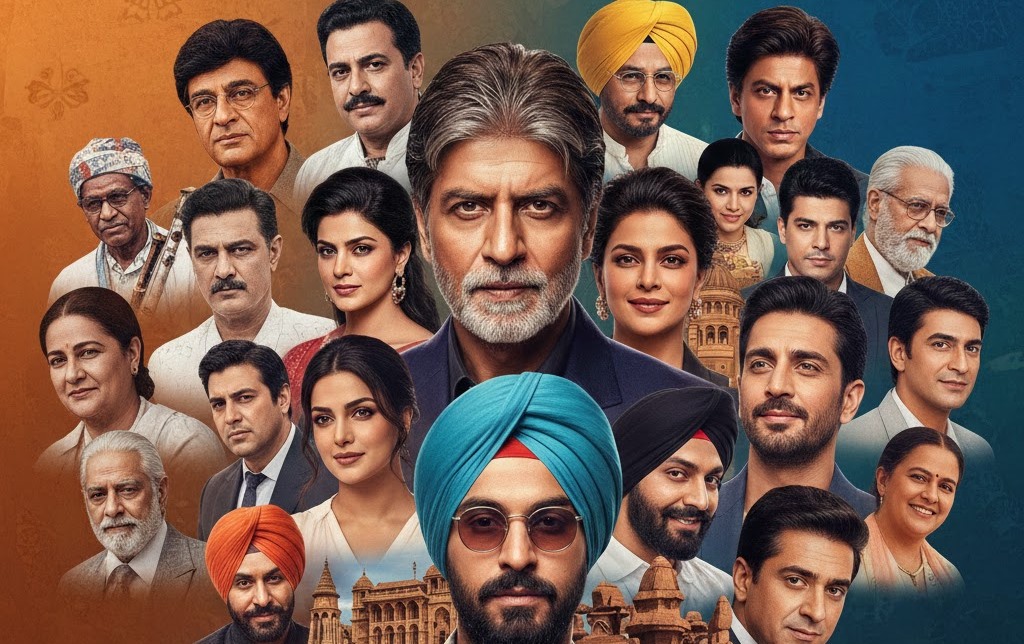
North India—a majestic geographic and cultural belt comprising Punjab, Haryana, Himachal Pradesh, Uttar Pradesh, Rajasthan, Uttarakhand, and Delhi—has served as the primary heartbeat of the Indian creative arts for over a century. From the rugged foothills of the Himalayas to the bustling lanes of Chandni Chowk, this region has birthed a galaxy of legends. These stars have not only defined mainstream Bollywood but have also carved a niche in regional cinema and made indelible marks on Hollywood. The story of North India’s contribution to the arts is a saga of grit, talent, and an unwavering connection to one’s roots.
The Architecture of Stardom: The “Punjabi” Foundation
The very DNA of the Indian film industry is woven with North Indian threads. The “First Family of Indian Cinema,” the Kapoor Family, originally hailed from Peshawar but became the face of the North Indian/Punjabi identity in Mumbai. From Prithviraj Kapoor to Raj Kapoor, and now Ranbir Kapoor, they brought the high-energy, emotional, and musical spirit of the North to the silver screen.
This legacy was fortified by the “Superstar” era. Rajesh Khanna, the first man to witness unparalleled mass hysteria, was born in Amritsar, Punjab. He was followed by the “He-Man” of India, Dharmendra, from Sahnewal, who introduced a new brand of masculinity—tough yet tender—later carried forward by his sons Sunny and Bobby Deol. In modern times, this Punjabi mantle is held high by Vicky Kaushal and Ayushmann Khurrana, actors who blend traditional North Indian sensibilities with contemporary realism.
The Delhi-UP Influence: Intellectualism and Raw Talent
If Punjab provided the energy, Delhi and Uttar Pradesh provided the intensity and the “Common Man” appeal. Amitabh Bachchan, the “Shahenshah,” born in Allahabad (Prayagraj), used his baritone voice and towering presence to become the voice of a frustrated generation in the 70s. Similarly, Shah Rukh Khan, though the “King of Romance” in Mumbai, is a Delhi boy at heart. His wit, academic discipline, and “outsider” success story are products of the Delhi theater circuit and St. Columba’s schooling.
Uttar Pradesh has also been a nursery for method acting. Naseeruddin Shah (Barabanki) and Nawazuddin Siddiqui (Budhana) proved that you don’t need a “heroic” physique to rule the screen; you need raw, unadulterated talent. Priyanka Chopra Jonas, born in Jamshedpur but a self-proclaimed “girl from Bareilly,” took this UP grit to Hollywood, becoming a global icon through Quantico and Citadel.
The Himalayan Gems: Himachal and the Artistic Spirit
The serene hills of Himachal Pradesh have produced artists with a distinct, soulful depth. Anupam Kher, a proud Shimla boy, has navigated a career spanning over 500 films, becoming one of India’s most recognized faces in international cinema with projects like Silver Linings Playbook. Preity Zinta, from Rohru, brought a fresh, bubbly energy to Bollywood, while Kangana Ranaut from Mandi redefined the “rebel” actress, winning four National Awards and proving that a girl from a small mountain town can challenge the industry’s biggest giants.
Even in the world of visual arts, the North has been a sanctuary. Amrita Sher-Gil, often called India’s Frida Kahlo, found her muse in the hills of Shimla. Sobha Singh, the legendary painter of the Sikh Gurus and folk tales like Heer-Ranjha, worked from his studio in Andretta, Himachal, blending spiritualism with fine art.
The Sound of the North: From Classical to Coachella
The auditory landscape of India is dominated by Northern voices. Mohammed Rafi (Punjab), arguably the greatest playback singer ever, possessed a range that remains the gold standard. Sonu Nigam (Haryana) and the soulful Mohit Chauhan (Himachal) have carried this playback legacy into the modern era.
However, the North’s greatest musical export today is the “Punjabi Wave.” Legendary folk icons like Gurdas Maan laid the groundwork, which was then expanded into the pop-rap revolution by Yo Yo Honey Singh, Badshah, and Mika Singh. The late Sidhu Moose Wala became a global phenomenon, charting on Billboard and bringing the raw stories of rural Punjab to the streets of Toronto and London. Diljit Dosanjh recently cemented this global dominance by performing at Coachella, proving that the Punjabi language and rhythm are truly universal.
The Producers and Visionaries
Behind every great star is a visionary producer or director, and many of these architects are North Indians. From the legendary Yash Chopra (Jalandhar), who gave us the romanticized vision of the Swiss Alps mixed with Punjabi weddings, to Boney and Anil Kapoor, the region has consistently produced the “money and brains” behind the blockbusters. These producers created a niche for North Indian stories—festivals, large families, and the spirit of “Chardi Kala” (eternal optimism)—which has now become the standard definition of “Indian Culture” for the world.
Crossing Borders: The Hollywood Leap
The ambition of North Indian stars has never been restricted by geography. Irrfan Khan (Rajasthan) became the most respected Indian face in Hollywood, starring in Life of Pi and Jurassic World. Arijit Singh, despite his mixed roots, has become the voice of Northern romance worldwide. These artists didn’t just join mainstream cinema; they transformed it. They brought a specific “Mitti ki Khushbu” (scent of the soil) that was missing in the globalized world.