


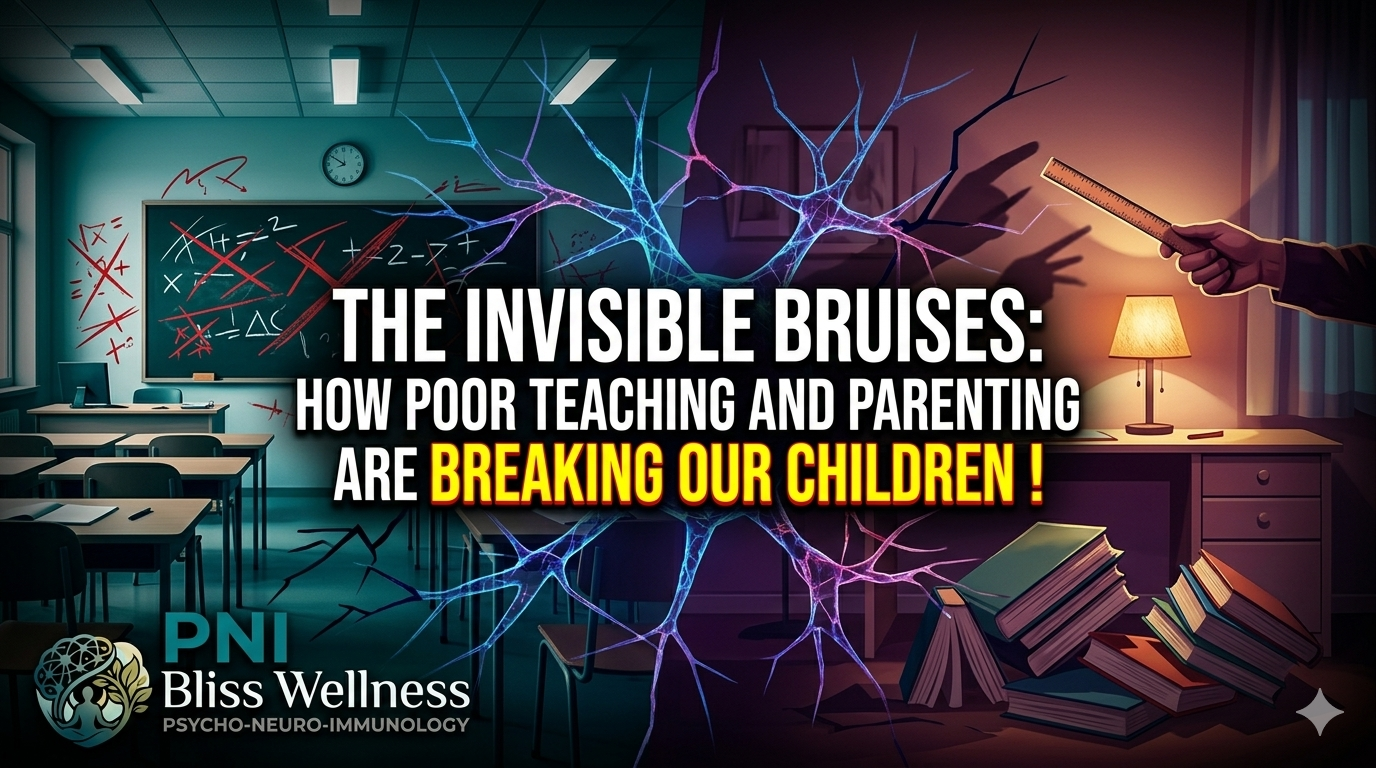
SOLAN, Himachal Pradesh — A 7-year-old girl from Solan, identified only as Bhairvi to protect her identity, has become the face of a growing child mental health crisis in India after being diagnosed with post-traumatic stress disorder — triggered not by war or disaster, but by the very adults entrusted with her care.
Sanvi’s symptoms — uncontrollable shivering, persistent weeping, and a paralysing fear of raised voices — have prompted mental health professionals to issue a stark warning: poor teaching practices and emotionally unregulated parenting are quietly breaking a generation of children.
A Classroom Turned Battlefield
According to wellness expert Dr. Manjeet Sehgal, founder of PNI Bliss Wellness, Bhairvi’s trauma began in first grade when repeated harsh scolding by her teacher shattered her sense of safety.
“When a teacher uses fear as a tool for discipline, they are not teaching — they are triggering a survival response in the child’s brain,” said Dr. Sehgal.
Mental health advocates point to a systemic gap in India’s private school sector, particularly in smaller towns, where junior teachers are routinely hired based on academic qualifications alone, with little to no training in child psychology or trauma-informed instruction.
The Home Front: When ‘Mom Rage’ Follows Children to School
Bhairvi’s ordeal did not end at the school gate. Experts say the phenomenon, increasingly referred to as “Mom Rage” — explosive, high-decibel anger directed at children during the morning routine — was compounding her distress before she even arrived in class.
“By the time a child like Bhairvi leaves for school, her nervous system is already exhausted,” Dr Sehgal explained. “Parents who are short-tempered often forget that their children do not have the biological tools to process an adult’s unregulated anger.”
The result, clinicians say, is Anticipatory Anxiety — a state in which a child dreads the day ahead before it has even begun.
The Science Behind the Shiver
Dr. Sehgal, who approaches child wellness through the framework of Psycho-Neuro-Immunology (PNI), says Sanvi’s physical symptoms are not merely psychological — they are physiological.
“Her brain’s alarm system, the amygdala, is stuck in the ‘on’ position,” he said. “The shivering is her body literally attempting to discharge excess stress energy.”
The long-term implications are equally alarming. Chronic stress in early childhood has been shown to suppress the immune system, leaving children more vulnerable to digestive disorders, frequent infections, and long-term mental health conditions.
What Needs to Change
Dr. Sehgal and fellow advocates are calling for concrete reforms on two fronts:
In schools: Mandatory empathy and trauma-awareness training for all junior teaching staff, moving away from volume-based discipline toward emotionally intelligent classroom management.
At home: Adoption of what Dr. Sehgal terms “Low-Volume Parenting” — a model that prioritises discipline through connection rather than correction, and builds what he calls “safe attachment figures” for children.
‘The System Is Broken, Not the Child’
Mental health professionals are urging communities to abandon the notion that children should simply “get over” emotional distress.
“If a child is shivering at the sound of a raised voice, the system around them is broken — not the child,” Dr. Sehgal said. “Healing begins when we replace shouting with shielding. Our schools and homes must become sanctuaries, not sources of trauma.”
Bhairvi’s case, experts say, is not an anomaly. It is a mirror held up to a society that has long overlooked the invisible bruises it leaves on its youngest members.
—
Wellness insights contributed by Dr. Manjeet Sehgal, Founder, PNI Bliss Wellness.
